

This report, Redefining Risk: The Cost of Not Funding Women’s Rights Organisations, investigates the critical consequences of defunding and suppressing feminist movements globally. While donors often focus on the perceived risks of funding Women’s Rights Organisations (WROs)—such as “absorption capacity” or “misuse of funds”—this study argues that the far greater risk lies in the inaction and the subsequent erosion of gender equality progress.
Language: En
Introduction
This study by EM2030 and the AFM seeks to strengthen the evidence base for advocates and funders who look to direct more and better funding to WROs.
We know many donors face significant public and internal scrutiny over the perceived risks associated with funding WROs. These risks include scrutiny over whether funding WROs delivers sufficient measurable results, alongside perceived risks related to absorption capacity and misuse of funds. The AFM has consistently raised this issue, which came up repeatedly with panellists during the Dutch-hosted Shaping Feminist Foreign Policy Conference in The Hague in 2023.
In this context, AFM and EM2030 aim to flip the narrative of ‘risk’ on its head, interrogating what risks to gender equality and broader development outcomes arise when robust, well-funded and well-supported WROs cease to operate. To do this, the study explores four country contexts in which feminist movements have experienced a decline in funding or closing civic space since 2000: Bangladesh, Nicaragua, Türkiye and Zimbabwe.
This research will contribute evidence for campaigners to use both within funding bodies and in the broader WRO space to advocate more and better resources for feminist movements and thereby bolster gender-equality progress across issues and contexts.
This report, developed by the Alliance for Feminist Movements with support from Mama Cash and Gender Funders CoLab, serves as a collective effort to map the devastating scope of current and future funding cuts to the feminist ecosystem. Updated as of May 15, 2025, this tracker is a living document intended to help partners and advocates visualize the “domino effect” of shifting donor priorities and government budget slashes that threaten to make the work of women’s rights organizations (WROs) nearly impossible.
Introduction
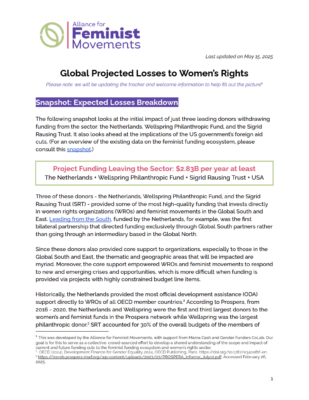
The global feminist funding landscape is facing an unprecedented withdrawal of resources, with at least $2.83 billion in project funding projected to leave the sector annually. This crisis is primarily driven by the closing of the Wellspring Philanthropic Fund, the cessation of the Sigrid Rausing Trust’s women’s rights program, and significant budget cuts from the Netherlands and the United States. These donors have historically provided some of the highest-quality “core” funding, which allows organizations in the Global South and East to remain agile and respond to emerging crises—a capability that is severely hindered when funding is restricted to narrow project line items.
The implications of these cuts are already proving to be life-threatening and far-reaching. For example, the dismantling of USAID and subsequent aid freezes are estimated to deny essential care to 11.7 million women and girls over a 90-day period. Beyond health, these reductions weaken advocacy efforts, reduce women’s leadership in humanitarian responses, and embolden anti-gender movements. In some regions, up to half of all women-led organizations in humanitarian crisis zones may be forced to shut down within six months.
This financial retreat is occurring at a critical junction: the 30th anniversary of the Beijing Declaration, a time when one in four countries is reporting a backlash against women’s rights. While funding for feminist movements remains fractional—amounting to just 0.7% of all gender equality ODA—anti-rights organizations have seen over $1 billion in directed funding in recent years. As gender equality stalls or regresses for 1.1 billion people globally, the Alliance for Feminist Movements urges a reversal of this trend, asserting that now is the time to accelerate investment in the movements that anchor broad human rights and sustainable development goals.