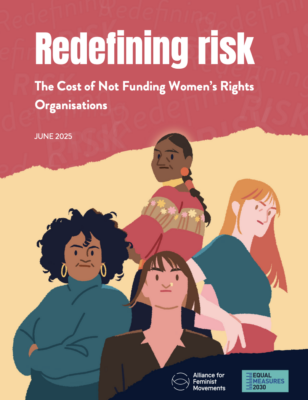
This report, Redefining Risk: The Cost of Not Funding Women’s Rights Organisations, investigates the critical consequences of defunding and suppressing feminist movements globally. While donors often focus on the perceived risks of funding Women’s Rights Organisations (WROs)—such as “absorption capacity” or “misuse of funds”—this study argues that the far greater risk lies in the inaction and the subsequent erosion of gender equality progress.
Type: AFM Publication
Introduction
This study by EM2030 and the AFM seeks to strengthen the evidence base for advocates and funders who look to direct more and better funding to WROs.
We know many donors face significant public and internal scrutiny over the perceived risks associated with funding WROs. These risks include scrutiny over whether funding WROs delivers sufficient measurable results, alongside perceived risks related to absorption capacity and misuse of funds. The AFM has consistently raised this issue, which came up repeatedly with panellists during the Dutch-hosted Shaping Feminist Foreign Policy Conference in The Hague in 2023.
In this context, AFM and EM2030 aim to flip the narrative of ‘risk’ on its head, interrogating what risks to gender equality and broader development outcomes arise when robust, well-funded and well-supported WROs cease to operate. To do this, the study explores four country contexts in which feminist movements have experienced a decline in funding or closing civic space since 2000: Bangladesh, Nicaragua, Türkiye and Zimbabwe.
This research will contribute evidence for campaigners to use both within funding bodies and in the broader WRO space to advocate more and better resources for feminist movements and thereby bolster gender-equality progress across issues and contexts.
This report, developed by the Alliance for Feminist Movements with support from Mama Cash and Gender Funders CoLab, serves as a collective effort to map the devastating scope of current and future funding cuts to the feminist ecosystem. Updated as of May 15, 2025, this tracker is a living document intended to help partners and advocates visualize the “domino effect” of shifting donor priorities and government budget slashes that threaten to make the work of women’s rights organizations (WROs) nearly impossible.
Introduction
The global feminist funding landscape is facing an unprecedented withdrawal of resources, with at least $2.83 billion in project funding projected to leave the sector annually. This crisis is primarily driven by the closing of the Wellspring Philanthropic Fund, the cessation of the Sigrid Rausing Trust’s women’s rights program, and significant budget cuts from the Netherlands and the United States. These donors have historically provided some of the highest-quality “core” funding, which allows organizations in the Global South and East to remain agile and respond to emerging crises—a capability that is severely hindered when funding is restricted to narrow project line items.
The implications of these cuts are already proving to be life-threatening and far-reaching. For example, the dismantling of USAID and subsequent aid freezes are estimated to deny essential care to 11.7 million women and girls over a 90-day period. Beyond health, these reductions weaken advocacy efforts, reduce women’s leadership in humanitarian responses, and embolden anti-gender movements. In some regions, up to half of all women-led organizations in humanitarian crisis zones may be forced to shut down within six months.
This financial retreat is occurring at a critical junction: the 30th anniversary of the Beijing Declaration, a time when one in four countries is reporting a backlash against women’s rights. While funding for feminist movements remains fractional—amounting to just 0.7% of all gender equality ODA—anti-rights organizations have seen over $1 billion in directed funding in recent years. As gender equality stalls or regresses for 1.1 billion people globally, the Alliance for Feminist Movements urges a reversal of this trend, asserting that now is the time to accelerate investment in the movements that anchor broad human rights and sustainable development goals.

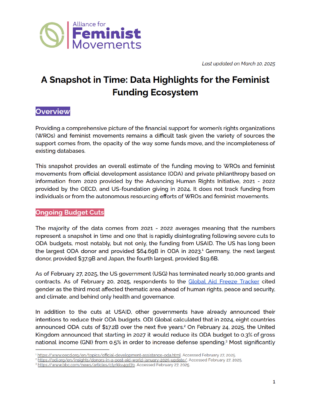
The Alliance for Feminist Movements (AFM) presents this overview of the financial landscape supporting women’s rights organizations (WROs) and feminist movements globally. Tracking this funding remains a complex challenge due to the diversity of funding streams, the lack of transparency in financial flows, and gaps in existing data. This report provides a critical analysis of funding from Official Development Assistance (ODA) and private philanthropy, based on the latest available data through March 2025.
Introduction
This snapshot arrives at a pivotal and precarious moment for feminist resourcing. While historical data provides a baseline for understanding funding trends, the ecosystem is currently experiencing rapid shifts due to significant budget cuts across major donor nations. Most notably, the United States—traditionally the world’s largest ODA donor—has terminated nearly 10,000 grants and contracts as of February 2025. These reductions are mirrored by other governments, including the Netherlands and the United Kingdom, who have announced substantial reductions to their future development budgets.
The data highlights a persistent gap between rhetoric and reality in feminist funding:
-
Only 4% of ODA currently has gender equality as its principal objective, a figure that has remained virtually unchanged since 2010.
-
Civil society organizations (CSOs) are receiving a smaller share of gender-focused ODA than they did a decade ago, dropping from 27% in 2011-2012 to just 19% in 2021-2022.
-
Support for WROs is highly concentrated, with just five donors accounting for 57% of total funding.
-
Of the funding reaching WROs, only a small fraction—approximately $29 million out of $432 million—goes directly to organizations based in recipient countries.
By consolidating data from the OECD, the Advancing Human Rights Initiative, and US-based foundations, this report aims to equip members and allies with the insights necessary to navigate these ongoing budget cuts and advocate for more sustainable, direct support for feminist movements worldwide.
The global struggle for the rights of women and girls is not just a moral imperative; it is a strategic necessity for a sustainable future for everyone. While gender equality is interwoven with every aspect of development, the world remains at a critical crossroads. Without a dramatic shift in commitment, we risk a “backtrack” scenario that could leave billions of women living in countries with poor equality scores. However, by following the “fast track” set by the world’s most progressive nations, we can achieve global gender equality as soon as 2049—nearly 60 years sooner than our current trajectory suggests.
Introduction
The Gender Equality 2049 report, produced by Equal Measures 2030 in collaboration with the Alliance for Feminist Movements, reveals that progress toward gender equality is currently too slow and fragile to meet the 2030 Sustainable Development Goals (SDGs). Nearly three-quarters of all SDG targets rely directly on the advancement of gender equality, yet at our current pace, the world will not reach this milestone until the year 2108.
This report highlights a stark divide between two possible futures:
-
The Fast Track: If all countries accelerate progress at the rate of the 15 fastest-improving nations, the global Gender Index score could reach a “fair” level by 2030, putting gender equality within reach by 2049.
-
The Backtrack: Conversely, one in three countries is currently making no progress or moving in the wrong direction. A global shift toward this “backtrack” scenario would lead to a dangerous reversal of rights, leaving 85% of the world’s girls and women in countries with “poor” or “very poor” equality scores.
A central finding of this research is the indispensable role of feminist movements. From mobilizing against femicide in Argentina to securing political quotas in Nepal, strong feminist advocacy is the most consistent driver of meaningful policy change. By examining case studies across five diverse nations—Argentina, Canada, Malawi, Nepal, and Uruguay—this report demonstrates that when feminist organizations are funded, listened to, and given space to lead, the “fast track” to 2049 becomes a reality.
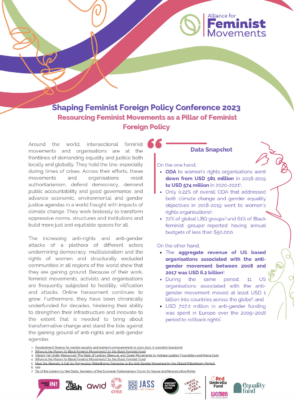
Intersectional feminist movements and organizations are at the frontlines of demanding global equality, defending democracy, and resisting authoritarianism. Despite their critical role in transforming oppressive structures and addressing crises like climate change, these groups face increasing hostility from anti-rights actors and remain chronically underfunded. This report, presented by the Alliance for Feminist Movements, outlines the urgent need to align international Feminist Foreign Policies (FFP) with bold, flexible, and abundant resourcing to support the activists leading the way toward a more just and equitable world.
Introduction
Across the globe, feminist activists and organizations serve as the primary defense against the erosion of human rights and the rise of anti-gender agendas. However, current funding landscapes reveal a stark disparity: while anti-gender movements in the US alone moved over USD 1 billion internationally between 2008 and 2017, Official Development Assistance (ODA) to women’s rights organizations actually decreased during the 2020-2021 period. Furthermore, grassroots groups—particularly Black feminist and global LBTQ organizations—frequently operate on annual budgets of less than $50,000.
To bridge this gap and fulfill the vision of the 2023 Political Declaration on Feminist Approaches to Foreign Policy, governments must move beyond rhetoric and toward transformative action. This involves not only increasing the quantity of aid—with a target of 10% of gender-focused ODA going directly to feminist organizations—but also improving the “quality” of funding through multi-year, core, and flexible support. By prioritizing the leadership of the Global South and adopting a “do no harm” approach to risk, Feminist Foreign Policies can effectively empower the movements that are essential to achieving lasting environmental, economic, and gender justice.
The Global Alliance for Sustainable Feminist Movements is a multi-stakeholder initiative launched at the Generation Equality Forum to significantly increase and improve financial and political support for feminist organizations and women’s rights movements. Functioning as a platform for collective action rather than a direct funding mechanism, the Alliance aims to create a space where the impact of joint efforts exceeds the sum of individual parts. The initiative’s Design Phase (scheduled through June 2022), was a period of intentional co-creation where members shared insights to determine the Alliance’s core principles, governance, and work plan.
Introduction
This report details the outcomes of the initial kick-off consultations held on December 8 and 9, 2021, and the results of a preliminary survey conducted among the Alliance’s Reference Group. With a 55% response rate, the survey captured the motivations and preferences of 78 member organizations, highlighting a strong collective interest in brainstorming future areas of work and refining organizational goals. The findings presented in this document reflect the Reference Group’s desire for a platform centered on:
-
Mutual Learning and Advocacy: A primary motivation for members is engaging in joint advocacy, solidarity, and movement strengthening.
-
Inclusivity and Intersectionality: Members emphasized the need for the Alliance to be inclusive of structurally excluded communities, including Indigenous women, LBTQI people, and young feminists.
-
Effective Funding Models: There is a clear call for the Alliance to champion core, long-term, and flexible funding for feminist movements.
By documenting these early preferences for engagement and feedback, this report serves as a roadmap for the Planning Group to adapt the Design Phase and ensure the Global Alliance effectively meets the needs of its diverse stakeholders.
This report outlines the key findings emerging from the second survey consultation with the Reference Group of the Global Alliance for Sustainable Feminist Movements (Global Alliance). This survey built on the feedback received during the first consultation with the Reference Group and focused on (1) clarifying the goals / objectives of the Global Alliance, (2) surfacing our assumptions about why the funding ecosystem is the way it is, and (3) starting to conceptualize the areas of work for the Global Alliance.
Introduction
The Global Alliance for Sustainable Feminist Movements is built on the belief that the future of gender justice depends on the strength, resilience, and interconnectedness of our movements. To ensure our collective efforts are both impactful and enduring, we must continuously listen to the voices of those on the front lines.
This report presents the findings from Consultation #2, a vital step in our ongoing journey to refine our mission and sharpen our strategic focus. Following our initial discussions, this second survey was designed to dive deeper into the practical needs and visionary goals of our members. It captures the perspectives of diverse stakeholders committed to building a world where feminist movements are not just reactive, but sustainably resourced and strategically aligned.
Purpose of this Report
The data and insights contained within this document serve two primary functions:
-
Clarifying Our Purpose: Synthesizing member feedback to define what makes our Alliance unique and necessary in the current global landscape.
-
Mapping the Roadmap: Translating raw survey data into actionable strategies that will guide our governance, advocacy, and resource mobilization efforts in the coming year.
By analyzing these results, we move from individual ideas toward a shared blueprint for action. We thank every participant who contributed their time and insight, helping us ensure that the way forward is one we pave together.